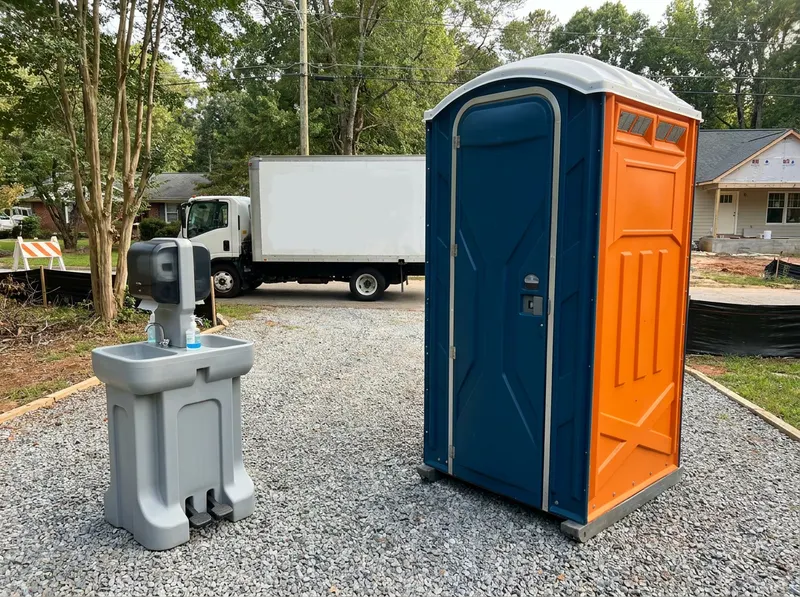
Orchidway Portable Toilets provides Handwash and Sanitizer Station in Jefferson, GA. A foot-pump handwash sink uses no electricity and no plumbing hookup. Step 1, the user presses a foot pedal; Step 2, fresh water from…
Orchidway Portable Toilets provides Handwash and Sanitizer Station in Jefferson, GA. A foot-pump handwash sink uses no electricity and no plumbing hookup. Step 1, the user presses a foot pedal; Step 2, fresh water from the onboard tank runs over the hands; Step 3, soap is dispensed from the mounted bottle; Step 4, paper towels at the side dry the hands; Step 5, greywater collects in a sealed lower tank that Orchidway Portable Toilets empties on each service visit. A twin-tap model feeds two basins, which keeps a line of framers or caterers moving instead of waiting on one tap. For situations where running water is not the goal, a stand-alone sanitizer stand holds a touch-free or push-top dispenser of alcohol-based hand sanitizer and needs only a level 2-foot-by-2-foot footprint. The U.S. CDC guidance on hand hygiene notes soap-and-water handwashing removes more types of germs than sanitizer alone, so a sink is the stronger fit wherever food, children, or visible dirt are involved; sanitizer stands suit entrances, exits, and roving points where plumbing a sink is impractical.
Decision-fit comes down to the work in front of you. A wedding reception near Memorial Park or an outdoor gathering at Jefferson City Park usually pairs restroom units with at least one twin-tap sink so guests wash before they eat, while a sanitizer stand by the dessert table covers quick top-ups. A roofing or grading crew along the Old Pendergrass Road corridor or a new build in Dove Creek, Planters Ridge, or Riverstone leans on a durable foot-pump sink near the trailer, since OSHA 1926.51 requires employers to provide handwashing facilities for construction workers, and the Portable Sanitation Association International recommends handwashing be located near the toilet units it serves. The trade-off is simple: a sink delivers real washing but carries a finite water tank between service visits, while a sanitizer stand never runs out of water but cannot replace soap-and-water cleaning before meals.
Siting the station matters for events in Traditions of Braselton, Lanier Springs, Wheeler's Mill, Cooper Falls, and Jefferson Station. The unit needs firm, level ground so the tank sits flat, and a clear path for the service truck to reach it. For a venue hosting more than 50 guests, one twin-tap sink per two restroom units keeps hands moving without a backup. On longer jobs, service frequency scales to use: a daily-use construction sink is commonly refilled once or twice a week, while a weekend event sink is stocked full at delivery. The Americans with Disabilities Act (ada.gov) sets accessibility expectations for public events, and a sink or dispenser mounted at an accessible height can be placed alongside an ADA-compliant restroom on request.
Stocking is straightforward: each station arrives filled with fresh water where applicable, a full soap reservoir, and a supply of paper towels; sanitizer stands ship with a sealed dispenser of alcohol-based gel. The FDA guidance on hand sanitizers advises a product with at least 60% alcohol, which is the grade stocked in the stands. Greywater from the sinks is handled as wastewater under state rules; the Georgia Environmental Protection Division governs how that waste is disposed, and EPA decentralized wastewater standards frame the disposal side of portable sanitation. Hand hygiene also sits within the broader workplace sanitation picture described by the NIOSH worker health program.
Every job gets a firm, written price after an on-site visit.
Tell us about your handwash and sanitizer station job in Jefferson and we'll send a clear, written quote, usually the same day.
 Orchidway Portable Toilets